The castle
Laissez vous conter Hodebert

The castle
The castle
The castle
The castle
The castle
The castle
The castle
The castle
its history and ours
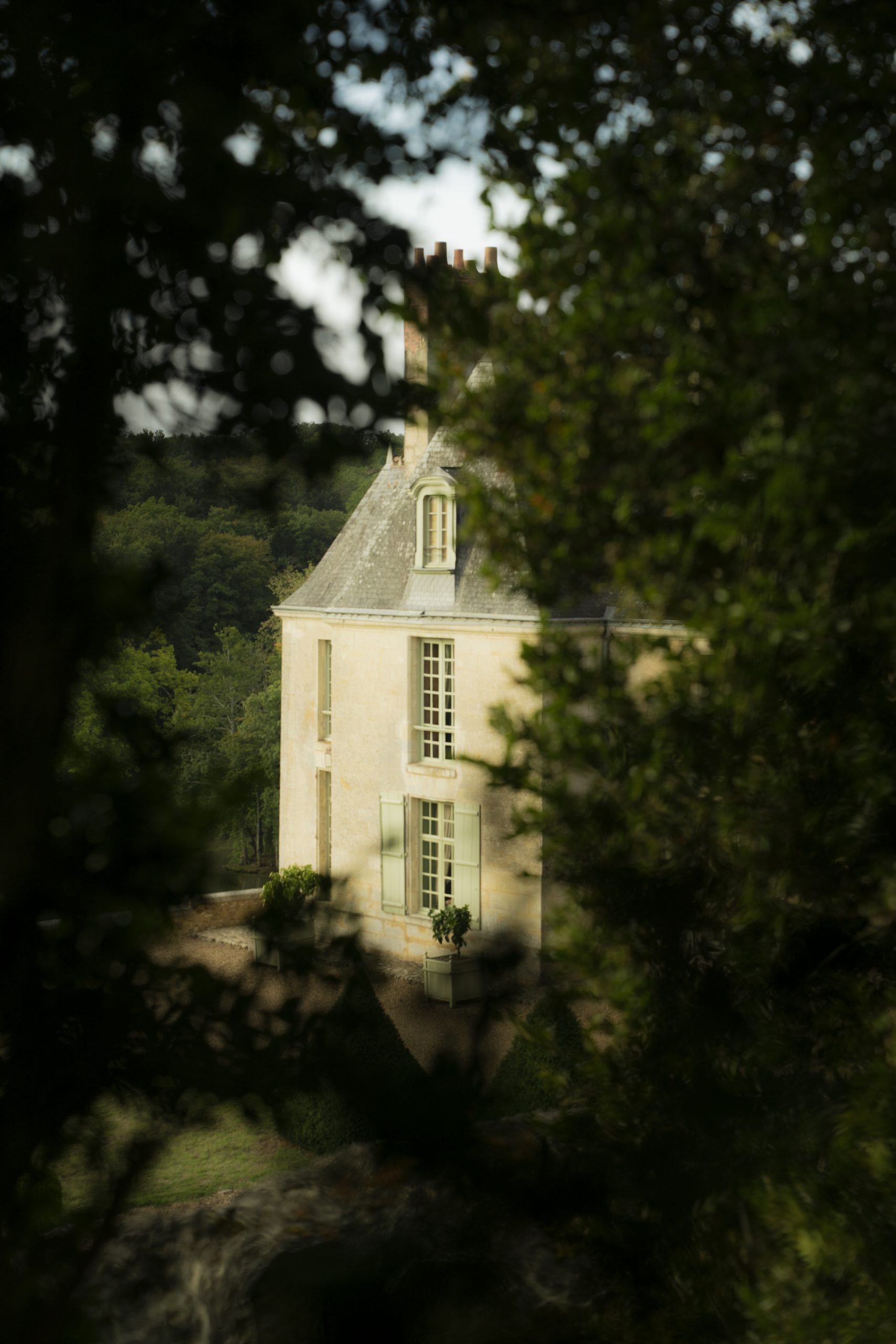
Un lien avec Louis XIV …
Les plus anciens documents retrouvés faisant mention d’Hodebert remontent au XVIème siècle. Après la famille Moreau, originaire du Poitou, Hodebert est acheté par Henri de Codosny en 1648. Ce dernier, d’origine italienne, dont la famille est arrivée en France avec Marie de Médicis était conseiller et maître d’hôtel du roi Louis XIV. Il se marie avec Marie Dunoyer, fille du bailli de Saint Christophe. De cette période date la partie centrale et le premier pavillon au nord d’Hodebert. Jean Dunoyer, son neveu, rachète Hodebert en 1674 pour rester dans cette famille jusqu’en 1794. Une centaine d’année plus tard, Claude Dunoyer, chanoine de la basilique Saint Martin agrandit le château et le modifie pour le remettre au goût du jour. En 1794, la propriété est achetée par Alexandre-François-Pierre Gouin, issu d’une grande famille de banquiers et négociants de Tours qui compte plusieurs maires. Son propre fils sera ministre de l’agriculture sous Louis Philippe. Il revend Hodebert en 1808 à Louis-François-de-Sales de Sarcé et son épouse Charlotte Françoise née Fontaine de Biré. Ils auront trois enfants qui habiteront tous Hodebert et qui d’un commun accord lègueront Hodebert à leur neveu Robert Roullet de la Bouillerie.
Les Sarcé agrandiront considérablement le domaine d’Hodebert en achetant l’abbaye de la Clarté Dieu, de nombreuses terres, des fermes, des moulins ainsi que le château du Breuil sur le vallon d’en face. Ils feront de très importants travaux sur le château et reconstruiront la totalité des communs avec un grand souci d’harmonie et d’homogénéité.
Robert de la Bouillerie quant à lui, entreprend dans les années 1920 des travaux importants de confort. Il fait installer le chauffage central, l’électricité et 7 salles de bain.
En 2004, Hodebert est à vendre et nous décidons de le racheter à notre famille. Nous quittons Paris avec notre fille ainée et nous nous installons en Touraine afin d’entreprendre une lourde et longue restauration dont Hodebert avait besoin. Cette belle histoire s’écrit à présent avec nos 4 filles qui nous aident à poursuivre l’aventure. Passion et détermination rythment notre quotidien afin de vous offrir l’authenticité d’un lieu dans lequel une famille française vit heureuse et s’épanouit.
The park has been listed as a Historic Monument since 1944 and the château since 2009.
Classic architecture
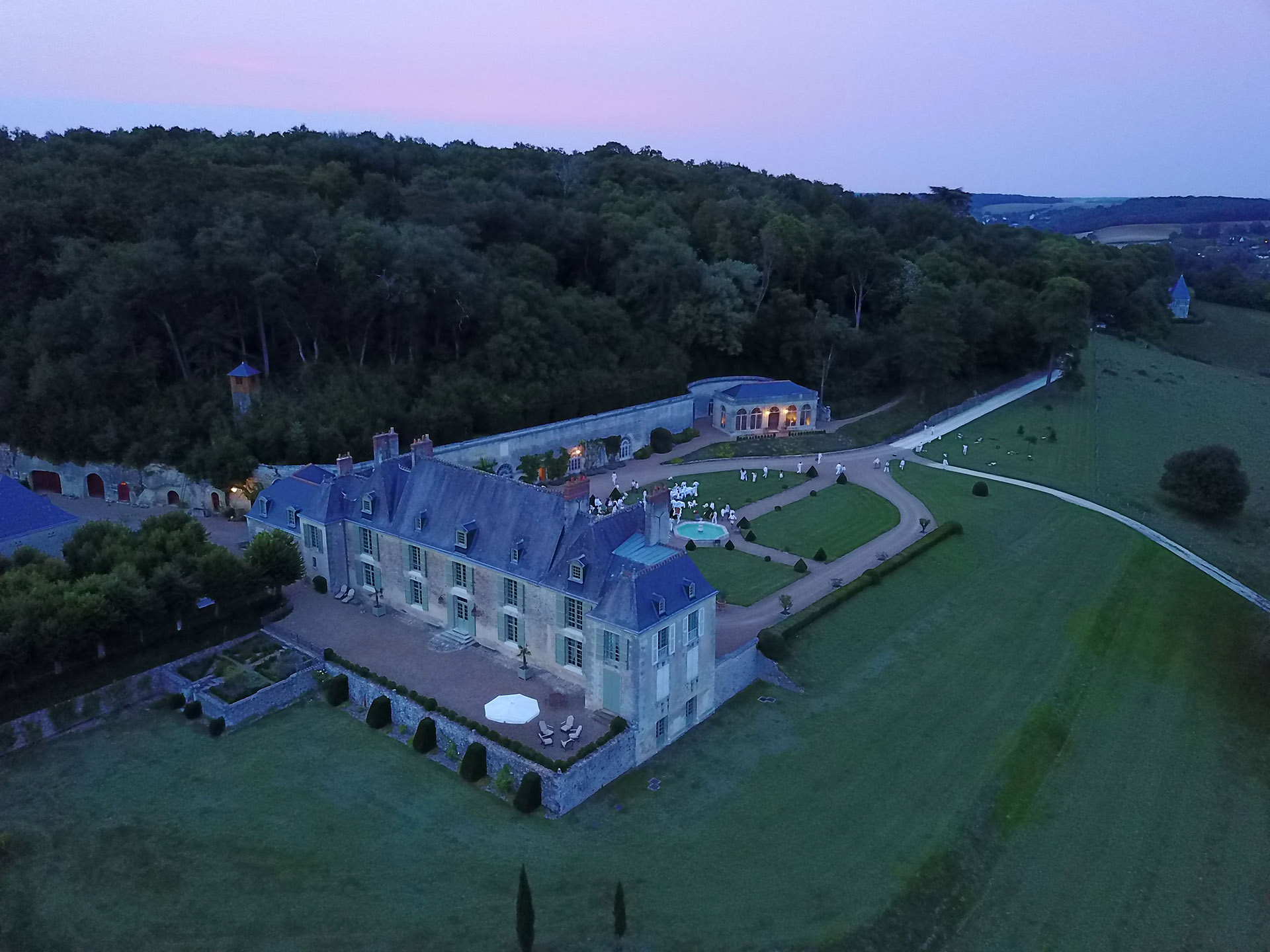
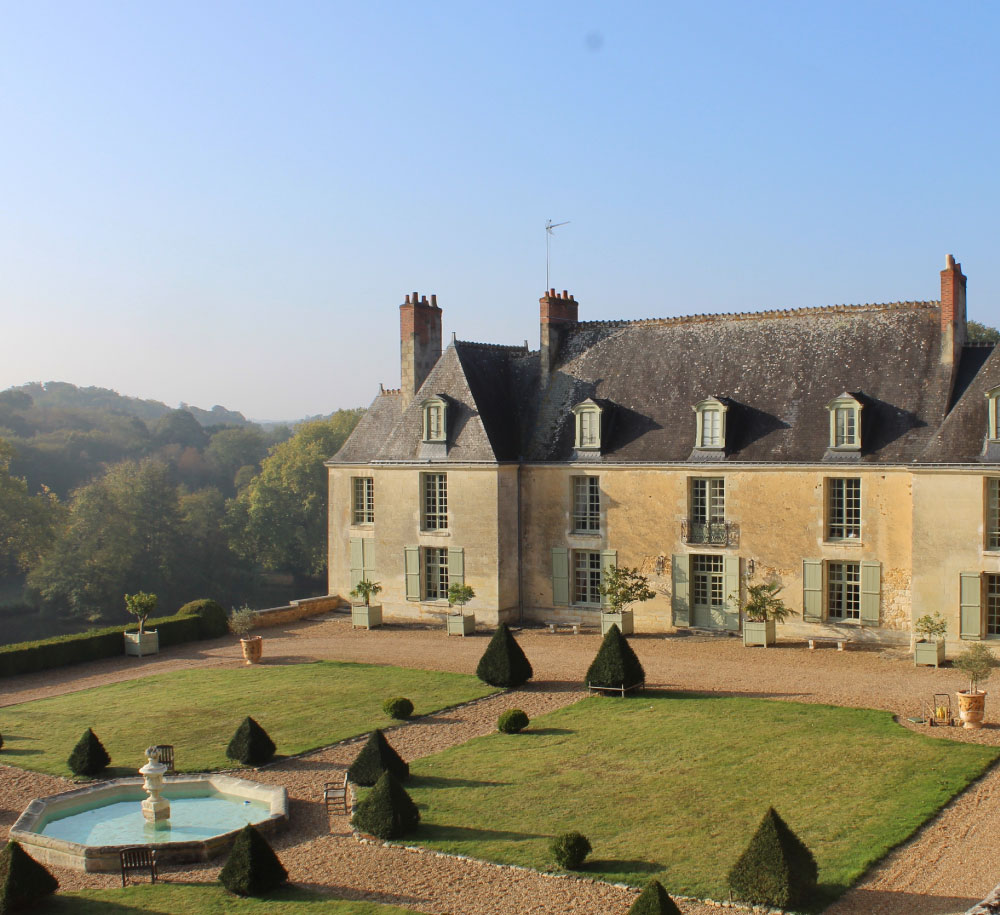
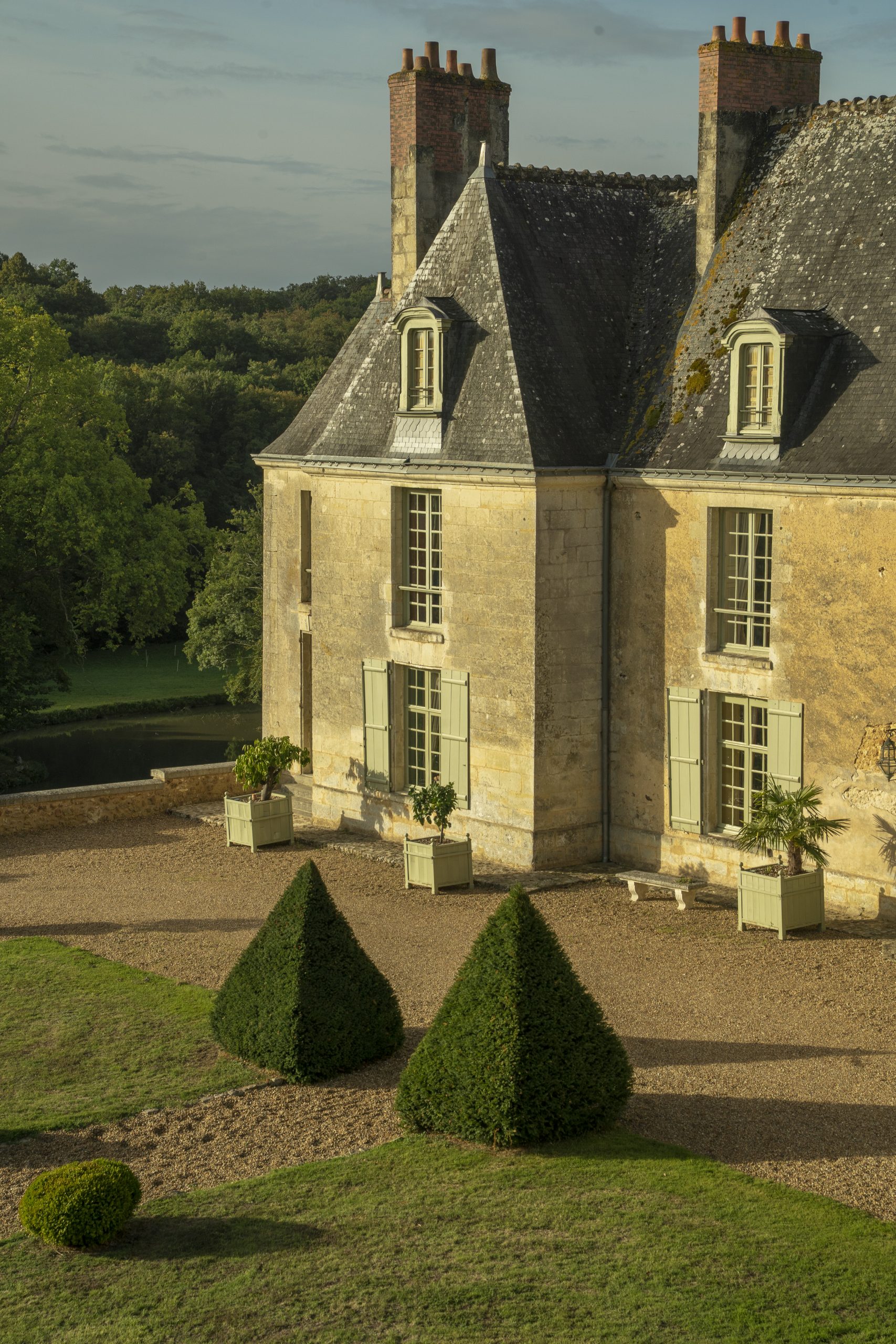
Hodebert Castle, as it stands today, is the result of three major building campaigns spanning some two hundred years. It is, however, not impossible that an earlier building, of which no trace remains, may have been constructed beforehand.
The oldest part, the central main building with three bays and a high gable featuring three dormer windows, appears to date from the late 17th century. Built in the classical style, this large building is likely the work of Jean Dunoyer (1633–1702), bailiff (judge) of Saint-Christophe from 1669 and purchaser of the seigneury of Hodebert in 1675. The two single-bay wings situated at either end of the main building, meanwhile, are thought to date from the third quarter of the 18th century; they were likely built by Jean-Jacques Dunoyer (1720–1793), also bailiff of Saint-Christophe, who settled permanently in Hodebert after parting with his seigneury of Gesnes. Finally, the two other single-bay pavilions extending from the two aforementioned ones date from the late 18th century.
The main residence is surrounded by numerous outbuildings. Indeed, Hodebert Castle has always been at the heart of a large agricultural estate comprising gardens, vineyards, a warren, coppice woodland, meadows, arable land and fallow land. In the 18th century, records mention several cellars dug into the nearby hillside (housing, in particular, a bread oven, a wine press and wine) and several traditional farm buildings (a barn, stables for horses, cowsheds and sheepfolds, and a ‘pigsty’). Before 1834, a single-storey building serving as a library, situated to the south-west of the château, as well as a carriage house to the west, were also constructed. Furthermore, stables, an orangery and greenhouses, situated below the château, were built during the 1870s. The Mansard-style covered porch was built in 1924; situated at the north corner of the château, it connects to the servants’ courtyard. Finally, it is worth noting that a private chapel was established within the château in 1891 with the permission of the Bishop of Tours at the request of Sébastien de la Bouillerie.
As for the ornamental features, sources from the early 19th century mention an avenue lined with elms (now lime trees); once through a magnificent gateway, this leads onto a vast main courtyard. On its northern side, one can see a painted sundial bearing the motto ‘ETSPE ET METU’ (‘Hope and Fear’). Furthermore, magnificent gardens enhance the site, which was listed in the Inventory by a decree of 25 September 1944.
Three main categories of property owners
Although the first known mention of Hodebert dates back to 1545, it is only from the mid-17th century onwards that we have a clear record of the château’s various owners. Following Henri de Codosny, the king’s councillor and master of the household, the property passed into the Dunoyer family in 1675, where it remained until the Revolution. In 1794, the property was purchased by Alexandre-François-Pierre Gouin, a merchant from Tours, who sold it in 1808 to Louis-François-de-Sales de Sarcé; his son Eugène Victor de Sarcé bequeathed Hodebert to his nephew Robert Roullet de la Bouillerie. In 2004, Hélie and Ivana de la Bouillerie bought it back from their family in order to continue this family adventure.
A distinguished guest in Hodebert
In the early 17th century, the provostship of Oë in Saint-Paterne, which came under the jurisdiction of the chapter of Saint-Martin de Tours, held its sessions in Hodebert. On 23 November 1620, Honorat de Bueil, the famous poet, was brought before the court there on the following charges: Racan claimed to be the founder of the parish church of Saint-Paterne on the pretext that, as Lord of La Roche, he had the right to display funeral banners there. Following the judgement, Sieur de Bueil was compelled to acknowledge that he owed fealty and homage to the provost of Oë and to take an oath of submission. He did so on the ‘Holy Gospels in accordance with the formula prescribed by custom’.
A Neolithic stationary polisher
Located on a terrace between two tributaries, the Hodebert site has been inhabited for a very long time. A fixed polishing stone (used to smooth tools by rubbing) bears witness to this; long unknown, it wasn’t until 1979 that prehistorians visited the site and confirmed its authenticity. Measuring 3.60 m long, 2.40 m wide, and 1.50 m thick, the enormous block of Eocene sandstone bears on its upper surface ten polishing grooves ranging from 20 to 50 cm in length and eleven cup marks. It is considered by experts to be one of the finest polishing stones in Touraine.